

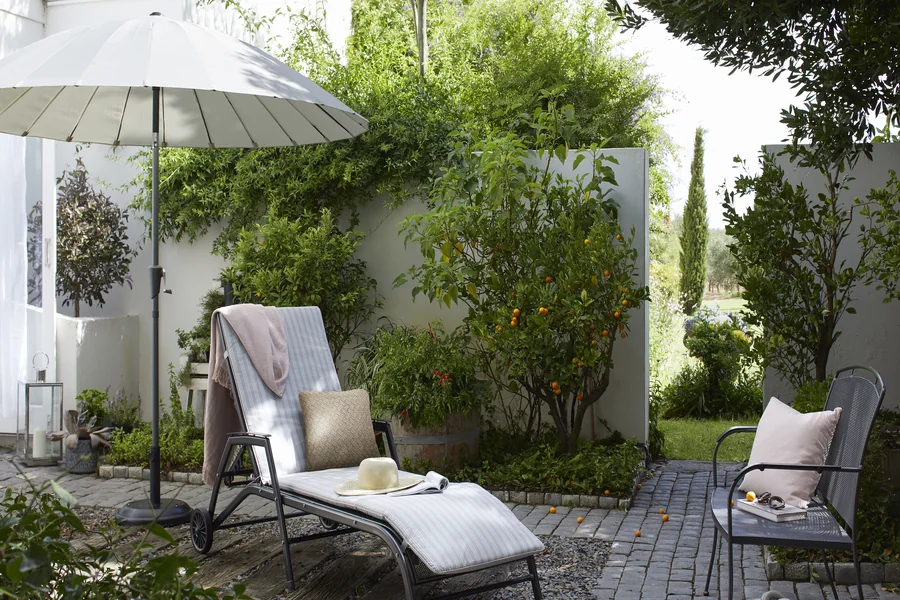
Outdoor space is precious, yet many of us find ourselves staring at a small patch of concrete or a narrow strip of grass, wondering how to turn it into those views we see in glossy magazines or online.
The truth is that having a small garden is not a limitation–it is an opportunity for high-impact design. The key is to stop thinking about what you can’t fit and start thinking about how to maximise the “visual volume” of the area.
Here’s how to make full use of your small garden and transform it into an outdoor area that feels twice its actual size.
1. Think Upwards Rather Than Outwards
In a small garden, the ground is your most limited resource, which means that to make the most of it, you’ve got to think vertically. Most British gardens are enclosed by timber fences or brick walls that are often left bare, which can make the space feel like a box.
However, if you treat these walls as vertical flower beds, you immediately draw the eye upward, creating a sense of height and breathing room.
Climbing plants are your best friends here. Varieties like Clematis, Honeysuckle, or the ever-popular Star Jasmine (Trachelospermum jasminoides) offer incredible fragrance and dense green foliage without taking up more than a few inches of floor space.
If you want something more modern, look up living wall systems. These modular planters allow you to create a “tapestry” of ferns, grasses, and even small perennials directly on your fence.
For those who want to be practical, vertical gardening can be the perfect solution for a kitchen garden. A simple wooden pallet or a series of wall-mounted pots can house a surprisingly large bounty of mint, rosemary, thyme, and chillies.
As you lift plants off the ground level, you clear the floor for furniture and movement. This is an important first step in making a small space feel like a functional room rather than a storage area.
2. Divide The Space Into Practical Zones
It might sound counterintuitive to break up a small area into even smaller sections, but zoning is one of the most effective ways to make a garden feel larger. When you can see the entire garden at a glance, the brain quickly registers its small dimensions.
However, if you create “rooms” or distinct areas, you create a journey. Even in a tiny plot, you can distinguish between a dining area, a lounge corner, and a planting zone.
You don’t need walls to do this–you can actually use “visual anchors” like a change in flooring material or a strategically placed large pot.
For instance, you might have a small paved area near the house for a bistro set, followed by a narrow gravel path that leads to a slightly raised wooden deck at the back. This change in level—even if it is only a few inches—tricks the mind into thinking there is more to explore.
Using “see-through” barriers like tall, airy grasses or a decorative metal screen can also help define these zones without blocking the light or making the garden feel enclosed.
When you sit in one zone, the other areas become the “view,” which provides a sense of depth that a single open space simply cannot offer.
3. Choose A Calm And Consistent Colour Palette
One of the fastest ways to make a small garden feel cluttered is to fill it with too many different colours and textures.
In a large border, a riot of colour works, but in a small space, it is just too overwhelming. So, it is for the best if you stick to a limited palette of three or four colours.
Many British designers opt for a “cool” palette of whites, soft blues, and silver-greys. These colours tend to recede from the eye, making the boundaries of the garden feel further away than they actually are.
Focus on the foliage just as much as the flowers. Using different shades of green is useful as it can create a layered look that feels pleasing and well-considered.
When choosing pots and furniture, ensure they go with your plant choices or the colour of your house. For example, charcoal grey pots against a brick wall can look very sleek, or classic terracotta can add warmth to a shady corner.
You create a sense of rhythm and flow through the repetition of the same plants and colours. And, this consistency prevents the eye from getting “stuck” on a single jarring element, allowing it to glide across the space and perceive it as one harmonious whole.
4. Use Mirrors And Clever Lighting To Add Depth
Visual trickery is a staple of professional garden design, and nothing works quite as well as a garden mirror.
When placed correctly on a boundary wall, a mirror can reflect the greenery and light, making it look as though there is a “secret garden” through a doorway. It is a classic trick that works wonders in narrow side-returns or shaded patios.
Just ensure the mirror is positioned so it doesn’t reflect the bins or a plain brick wall, and consider using a distressed or “window-style” frame to make it look like a natural architectural feature.
Lighting is the other part of the equation. In the UK, we often only think about our gardens when the sun is out, but a well-lit garden can be enjoyed from the comfort of your living room all year round.
Instead of one bright floodlight that flattens everything, you should go for “layered” lighting. Small LED spotlights can be tucked into planters to uplight a focal point tree or a beautiful texture on a wall.
Stringing festoon lights overhead creates a “ceiling” of light that makes a seating area feel intimate and cosy.
By lighting the back of the garden while leaving the middle in soft shadow, you create a sense of distance and mystery that makes the plot feel significantly deeper at night.
5. Stay On Top Of The Tiniest Details
In a small garden, there is nowhere for neglect to hide. A large garden can handle a bit of “wildness” around the edges, but in a compact space, a few stray weeds or an overgrown shrub can quickly make the whole area look messy.
This is why maintenance is the final, and perhaps most important, step in making full use of your space.
Regular pruning is vital to ensure that your plants don’t grow out of proportion with the garden. You want your plants to look lush, but not like they are staged a coup against your seating area.
Keep your lines sharp. Whether it is the edge of a small lawn or the gap between paving stones, clean lines create a sense of order that makes a space feel professional and airy.
Many people find that because the area is small, they can afford to invest in higher-quality materials or more frequent professional care.
Getting professional local gardening services in Luton, or anywhere in the UK for that matter, to help with the “heavy” tasks can make the difference between a yard that feels like a chore and a garden that feels like a luxury retreat.
When the hardscaping is clean, and the plants are healthy and well-groomed, the garden will always feel like a deliberate, high-end extension of your home.
Conclusion
So, that’s how you transform your small outdoor area in 5 easy steps.
Remember that a garden is a living thing–it will change with the seasons and grow over time, so staying on top of the maintenance is important.
That’s the only way not only to create a great impact, but also to enjoy it all year round!
