

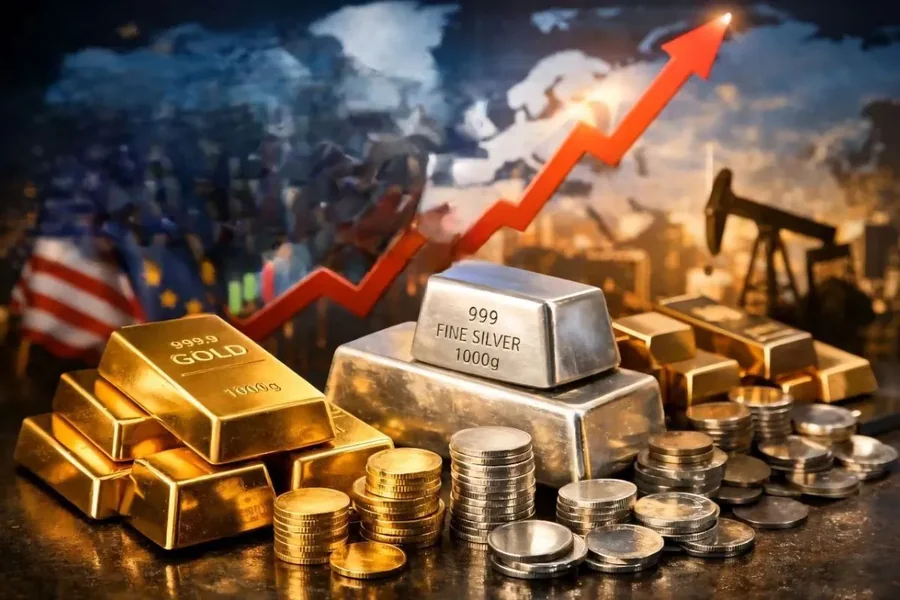
If you have been watching gold and silver lately, you have probably noticed something unusual. The world feels unstable. Conflicts are rising, oil prices are climbing, and inflation refuses to settle. Yet precious metals are not reacting the way many expect.
So what is really going on?
Right now, the biggest force shaking the market is geopolitical tension in the Middle East, particularly involving Iran. Any threat to oil supply routes pushes energy prices higher. When oil climbs, everything else from transport to food becomes more expensive. That usually sends investors rushing to gold as a safe haven.
But this time, the reaction is more restrained.
Gold prices have been relatively steady, and at times have even dipped. One major reason is the pressure from high interest rates. Central banks, especially in the United States, are keeping rates elevated to control inflation. When interest rates remain high, gold becomes less appealing because it does not generate income. Investors start looking for assets that offer returns.
This creates a push and pull effect. Uncertainty drives interest in gold, while high interest rates reduce its appeal.
Silver is facing an even more complex situation. Unlike gold, silver plays a dual role. It is both a store of value and an industrial metal used in electronics, solar energy, and manufacturing. When the global economy slows, demand for silver tends to fall.
That is what is happening now. Rising energy costs are putting pressure on businesses, and production is slowing across key industries. As a result, silver prices have seen sharper declines compared to gold. This highlights how closely silver is tied to economic activity.
Another important factor is the role of central banks. Countries such as China and Turkey have been increasing their gold reserves. This is a strategic move to reduce dependence on the U.S. dollar and to protect against global financial uncertainty.
This steady demand is helping support gold prices, even during periods of volatility.
At the same time, some countries are moving in the opposite direction. Faced with rising oil costs and currency pressure, they are selling portions of their gold reserves to stabilize their economies. This creates a unique situation where buying and selling are happening at the same time, adding to market uncertainty.
Recent market performance reflects this tension. In March 2026, gold experienced one of its worst monthly declines since the 2008 financial crisis, despite ongoing geopolitical risks. This kind of movement shows how complex the current environment has become.
So where does this leave gold and silver?
The answer is not simple. These metals are now influenced by multiple forces at once. Geopolitical risks, inflation, interest rates, industrial demand, and currency movements all play a role. At times, one factor dominates. At other times, another takes over.
For investors, the key takeaway is clear. Understanding gold and silver today requires looking at the broader global picture. It is no longer enough to rely on traditional patterns.
In today’s environment, gold and silver act as signals of a world adjusting to uncertainty. Their movements reflect not just market trends, but the shifting balance of the global economy itself.
This article was brought to you by:
Suite 2, Level 1, 110 Liverpool St
Hobart, TAS, 7000
(03) 6244 2660
